Key takeaways
- Custom AI agents take action — CRM queries, meeting booking, ticket updates — not just FAQ replies.
- Production stacks combine Claude/GPT, RAG, tool use, and human-in-the-loop approvals.
- US MVP budgets: $25k–$55k for one workflow with 1–2 integrations.
- Start with one high-volume workflow and measure ROI before scaling to multiple agents.
- Eval datasets and logging are non-negotiable for enterprise US deployments.
What Is a Custom AI Agent?
A custom AI agent is software that uses large language models to reason, retrieve private data, call external APIs, and execute multi-step workflows without a human clicking through every step. Unlike a generic ChatGPT wrapper, a production agent is built around your business rules, your CRM, and your knowledge base.
US businesses deploy custom agents when off-the-shelf chatbots cannot access internal systems, enforce brand voice at scale, or meet compliance requirements for audit trails and data residency. Common deployment surfaces include web dashboards, embedded widgets, Slack/Teams bots, and mobile apps for field teams.
GKAI Studio builds custom agents for US startups and enterprises — see our AI agent development services, support agent product, and lead qualification agent for reference architectures.
Custom AI Agents vs Chatbots: What Changed in 2026
Traditional chatbots follow decision trees or keyword matching. Modern agents use tool use — the model decides which API to call, when to search your knowledge base, and when to escalate to a human. The difference shows up in resolution rate: US support teams report 40–60% tier-1 deflection with RAG-backed agents versus 10–15% with FAQ-only bots.
Agents also maintain conversation context across sessions when paired with CRM data. A lead who returns three days later gets continuity — the agent knows prior qualification answers and open tickets. That depth requires custom integration work, which is why US companies hire development partners instead of configuring no-code widgets alone.
The winning 2026 pattern: one agent, one workflow, measurable KPIs for eight weeks — then expand.
Architecture & Production Stack
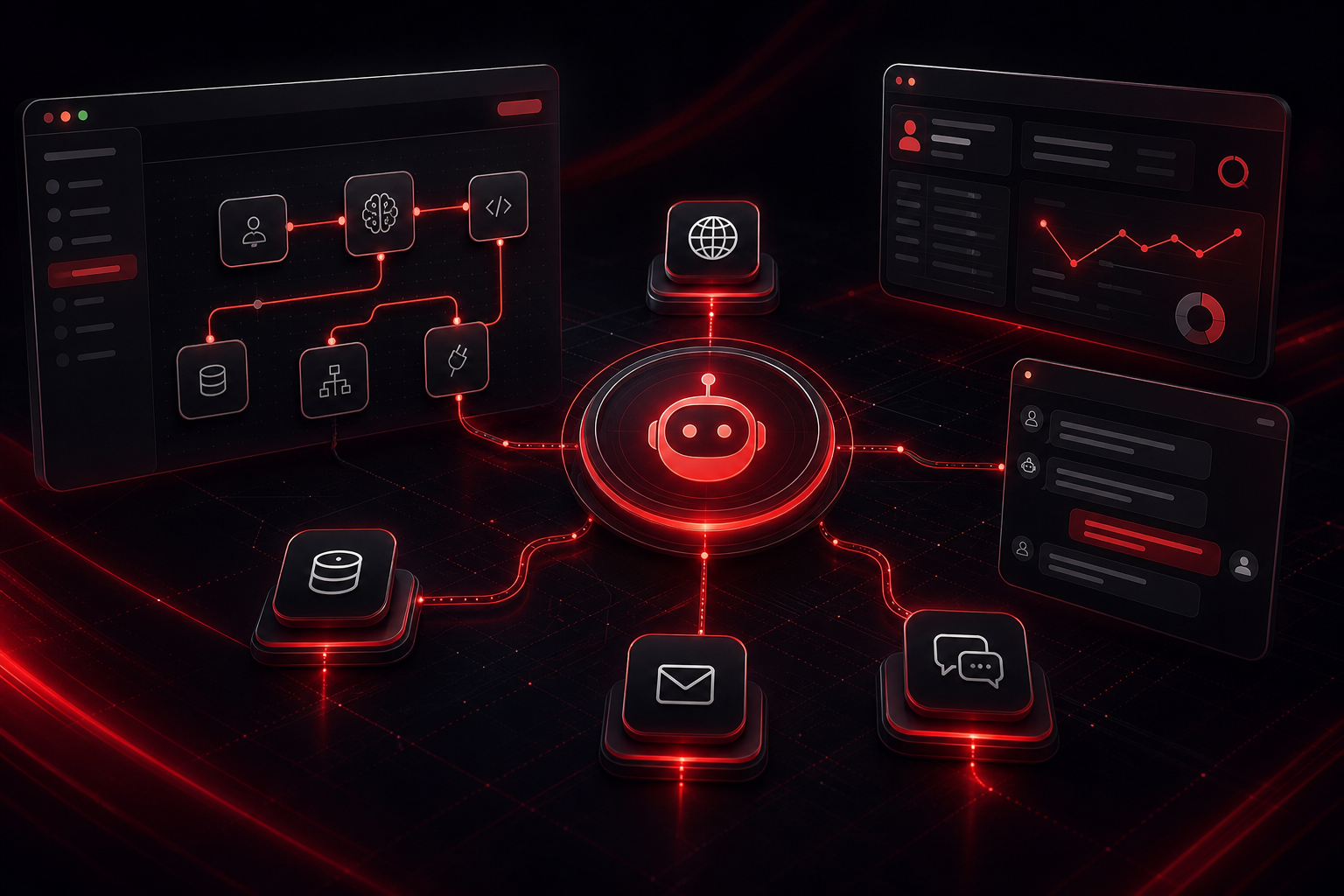
Every production agent system we ship combines six layers. Skipping any layer causes failures in US enterprise reviews.
1. Model layer
Claude and/or GPT via enterprise API agreements. Azure OpenAI when strict Azure tenancy is required. Model choice should be validated on your data, not marketing benchmarks.
2. Retrieval (RAG)
Vector search over docs, tickets, and policies. See our RAG architecture guide for chunking, reranking, and access control patterns.
3. Tool orchestration
LangChain, custom FastAPI services, or Node.js workers that expose CRM queries, calendar booking, email send, and database reads with rate limits and timeouts.
4. User surfaces
React/Next.js admin dashboards, customer-facing chat, and optional mobile apps for field workflows.
5. Guardrails
PII redaction, approval queues for high-risk actions, automatic fallbacks when confidence is low, and blocklists for prohibited topics.
6. Observability
Log every prompt, tool call, token cost, and human override. US compliance teams require this for SOC 2 readiness and internal audits.
High-ROI Use Cases for US Companies
- Customer support deflection — RAG over tickets and help docs; auto-draft replies; escalate edge cases with full context. Typical outcome: 40–60% tier-1 resolution and faster first response.
- B2B lead qualification — score leads against ICP criteria; sync HubSpot or Salesforce; book meetings on rep calendars. See AI sales automation.
- Proposal and SOW generation — pull CRM fields into branded templates; human review before send. See AI proposal generator.
- Internal knowledge search — employees query SOPs, HR policies, and engineering runbooks with cited sources.
- Document processing — extract fields from contracts, invoices, and onboarding PDFs into your systems.
- Ops automation — schedule reports, sync data between SaaS tools, notify teams on Slack when thresholds are hit.
Industry-specific examples: healthcare intake, legal client intake, real estate lead routing.
How to Build a Custom AI Agent (Step by Step)
Phase 1 — Discovery (1–2 weeks): Map one workflow end to end. Identify data sources, integration points, escalation rules, and success metrics. Define what the agent must never do autonomously.
Phase 2 — Prototype (2–4 weeks): Build RAG pipeline and 2–3 core tools. Test on a golden set of 50+ questions with expected answers and sources. Iterate chunking before adding UI polish.
Phase 3 — Production hardening (2–4 weeks): Add auth, logging, rate limits, admin dashboard, and human approval flows. Load test tool calls and set up monitoring alerts.
Phase 4 — Launch & iterate: Pilot with one team. Review failed tool calls weekly. Expand tools and surfaces only after KPI targets are met.
Cost & Timeline (USA, 2026)
These ranges reflect GKAI Studio engagements with US clients. Final scope is set after discovery — not from a pricing page alone.
- Focused MVP — $25k–$55k · 6–10 weeks · one workflow, RAG, 1–2 integrations, basic admin
- Agent + web dashboard — $45k–$90k · 10–16 weeks · multi-role auth, analytics, CRM write-back
- Agent + web + mobile — $75k–$150k+ · 14–24 weeks · field apps, offline sync, voice optional
- Ongoing retainer — $5k–$15k/month · eval maintenance, new tools, model upgrades
Full pricing breakdown: AI agent development cost USA. Related reading: 2026 agent guide blog post.
Choosing an AI Development Partner
US founders should vet partners on production evidence, not demo quality alone. Ask for:
- Case studies with eval metrics — resolution rate, time saved, cost per task
- RAG + tool-use experience on CRM and ticketing systems
- US timezone overlap for standups and incident response
- Full-stack capability — backend, web UI, and optional mobile
- Clear IP ownership and handoff documentation
Red flags: no mention of guardrails, "fine-tune first" without RAG discussion, or inability to explain logging and PII handling. Book a discovery call with GKAI Studio — we scope MVPs in the first 30-minute meeting.
Frequently Asked Questions
Most US MVPs ship in 6–12 weeks for one high-volume workflow with 1–2 integrations.
Yes, if answers must come from your private docs, tickets, policies, or product catalog.
Both work in 2026 — validate on your golden eval set before committing.
Yes via official APIs with OAuth and scoped permissions.
Focused US MVPs typically start at $25k–$55k for one workflow.
Human-in-the-loop approvals, confidence thresholds, PII redaction, and regression evals.
Ready to build with GKAI Studio?
AI agents, web apps, and mobile apps for US businesses — scoped in a free 30-minute discovery call.
Book a Discovery Call