Key takeaways
- RAG grounds LLM answers in your private data at query time — reducing hallucinations.
- Chunking strategy and metadata matter more than embedding model choice for most teams.
- Hybrid search (semantic + keyword) improves recall on SKUs, legal citations, and ticket IDs.
- Eval datasets and access controls are required for US enterprise RAG.
- Agentic RAG — where the model decides when to search — is the 2026 default for complex workflows.
What Is RAG (Retrieval-Augmented Generation)?
Retrieval-Augmented Generation connects large language models to your private data. At query time, the system retrieves relevant document chunks, injects them into the prompt, and generates an answer grounded in real sources — with optional citations for auditability.
In 2026, RAG is the default architecture for US enterprise copilots, support bots, and internal knowledge search. It is faster and cheaper to iterate than fine-tuning for most business use cases where documents change weekly or daily.
GKAI Studio builds production RAG for US companies — see RAG development services, our developer blog post, and the AI agent guide for how RAG fits into agent workflows.
The Production RAG Pipeline
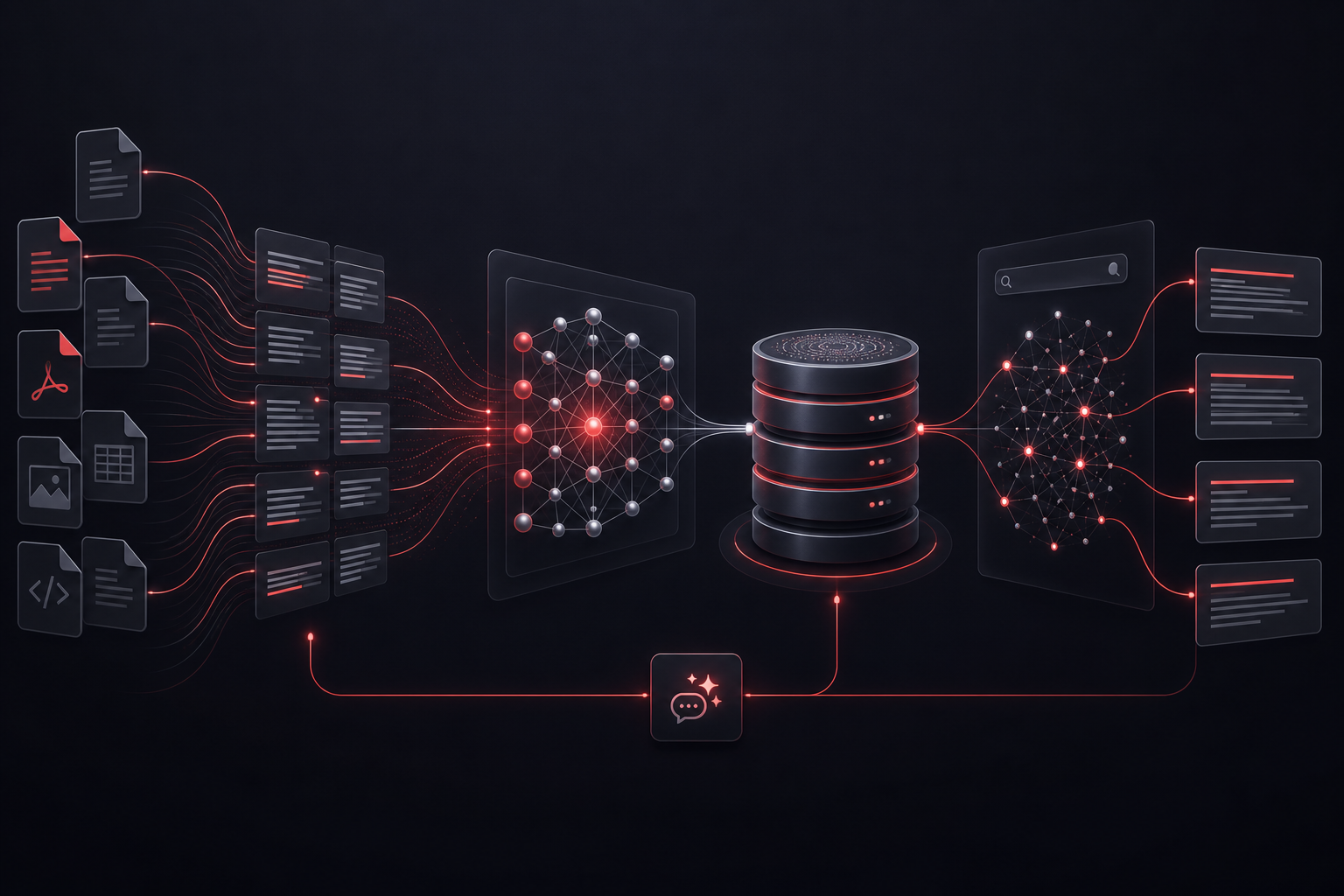
A complete RAG system has six stages. Weakness in any stage shows up as wrong answers in production.
- Ingestion — Load PDFs, HTML, Markdown, tickets, and database exports. Normalize encoding and strip boilerplate.
- Chunking — Split documents into searchable segments with metadata: source URL, doc type, last-updated, access role.
- Embedding — Convert chunks to vectors using OpenAI, Cohere, or open-source models. Batch and cache for cost control.
- Vector store — Pinecone, pgvector, Weaviate, or MongoDB Atlas Vector Search with indexes tuned for your query volume.
- Retrieval — Semantic search, optionally hybrid with BM25 keyword search for exact matches (SKUs, case numbers).
- Generation — LLM synthesizes answer with retrieved context; cite sources; refuse when confidence is low.
Chunking Strategy That Actually Works
Naive fixed-size chunks (512 tokens everywhere) destroy context. US teams that rank RAG quality highest use structure-aware splitting:
- Split by heading hierarchy in PDFs and wikis
- Keep tables intact or summarize tables separately
- Attach parent section title as metadata for disambiguation
- Overlap 10–15% between adjacent chunks for boundary questions
- Store version hash — re-embed only when content changes
For support tickets, chunk by conversation turn groups rather than individual messages. For legal and healthcare docs, respect paragraph boundaries for compliance review.
Retrieval, Reranking & Hybrid Search
Top-k semantic search alone misses exact keyword matches. Hybrid retrieval combines vector similarity with BM25 — critical for product IDs, policy numbers, and legal references.
Reranking with cross-encoder models (Cohere Rerank, bge-reranker) reorder top-20 candidates to top-5 with higher precision. The latency cost (50–150ms) is worth it for support and legal use cases.
Agentic RAG lets the model decide: search general docs vs. ticket history vs. ask a clarifying question. This pattern powers modern US support agents and internal copilots.
Production Patterns for US Enterprise
- Multi-tenant RAG — row-level security so users only retrieve allowed documents
- Human handoff — escalate when retrieval score is below threshold or user requests a person
- PII redaction — strip SSN, email, phone before indexing and before external LLM calls
- Citation enforcement — require source links in every customer-facing answer
- Cache layer — cache frequent queries; invalidate on document updates
Compare build vs buy: custom support vs Intercom Fin.
Evaluation, Monitoring & Continuous Improvement
Ship a golden eval set before launch — 50–100 questions with expected answers and required source documents. Run regression tests after every chunking, embedding, or model change.
Monitor in production: retrieval hit rate, citation accuracy, user thumbs-down rate, and escalation frequency. Review failed queries weekly — they become your next eval cases.
Teams that skip evals ship fast and fail loudly in front of customers. Budget two weeks for eval infrastructure — it pays back on the first pipeline change.
Frequently Asked Questions
RAG first for factual Q&A; fine-tune for tone at scale if needed.
pgvector, Pinecone, or Atlas — match to your ops stack and latency needs.
On every document create, update, or delete.
Minimum 50 for launch; 100–200 for enterprise regression.
Yes — filter chunks by user role at query time.
Ready to build with GKAI Studio?
AI agents, web apps, and mobile apps for US businesses — scoped in a free 30-minute discovery call.
Book a Discovery Call